The Nautical Motif Trap: When a Detail Does Too Much
Nautical motifs in coastal design can add character without turning a room into a themed set. Learn how to edit patterns and objects for a calmer finish.
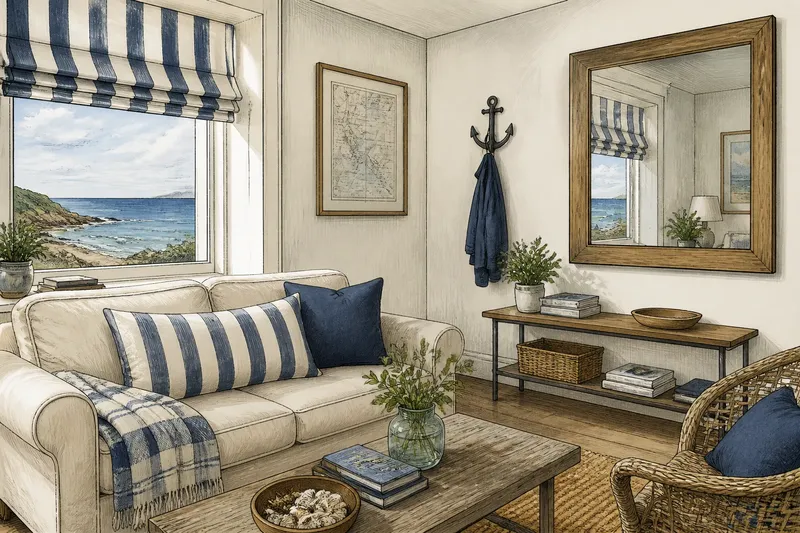
A striped cushion lands on a pale sofa; an anchor print goes above it, and a rope-framed mirror takes the next wall. Nautical motifs in coastal design can give a room character, but a cluster of familiar signs may turn useful objects into a themed set. The difference often lies in what each detail does beyond announcing the seaside.
A stripe can organise a seating area, an anchor hook can hold coats, and a harbour chart can recall a place that matters to the people who live there. When several objects all deliver the same message, however, their individual qualities become harder to see. Editing them is less about enforcing a style rule than giving each piece room to contribute something distinct.
Give each object a role
Think of a motif as an object with two possible jobs: its practical or personal use, and the visual signal it sends. The strongest choices often do both. A striped blind may soften daylight while adding pattern; a framed chart may carry family meaning as well as colour and line.
Some objects are mainly decorative, and that is a perfectly good reason to keep one. The difficulty comes when several decorative pieces compete for attention without offering different kinds of interest. A small collection can feel considered if it brings together varied materials, shapes or memories; matching souvenirs that repeat one emblem can look more like merchandise on display.
Use motifs selectively
- Sea-facing window: Check whether the view already draws the eye; if it does, choose one quiet motif or leave the window area clear, but if it does not, consider a patterned blind that gives the opening a visual frame.
- Plain wall: Check whether the wall needs a focal point; if it does, hang one harbour chart or a single bold print, but if nearby furniture already anchors the room, leave the wall open.
- Small seating area: Check whether a large pattern dominates the furniture; if it does, use a smaller cushion or a narrow stripe, but if the area feels visually unsettled, let one larger textile define it.
- Busy patterned room: Check whether another nautical pattern would compete with existing fabric; if it would, choose a plain object with a maritime connection, but if the patterns have distinct roles and clear space between them, retain both.
- Entrance or utility space: Check whether a decorative object can also help with daily use; if a sturdy anchor-shaped hook holds coats, keep it, but if a rope ornament catches on bags or gets in the way, replace it with a plain hook.
- Inherited or collected pieces: Check which objects carry a particular memory or local connection; if one does, give it a clear place, but if several tell the same story, rotate them rather than crowding them together.
These are decisions about the objects in front of you, not rules for every coastal room. A playful anchor can suit a child’s space, while a subtle stripe may still feel out of place beside an already busy arrangement.
Choose texture, not costume
Rope, canvas, timber and metal each bring a different texture. Their effect depends on the object they form and the other materials nearby. Rope on a sturdy handrail or a substantial handle has an evident physical role; rope wound around a mirror solely to label it nautical can feel like a costume when the rest of the room is smooth and restrained.
Stripes also vary in character. Woven cotton or linen tends to look different from a glossy printed surface, while a painted line on a wooden object has its own visual weight. The fabric or finish need not imitate a boat; it should suit the thing itself and the way that thing is used.
Recognisable emblems such as anchors make a direct statement. That can be part of their appeal, especially when an object is useful or has personal meaning. A good edit preserves that particular quality rather than surrounding it with several more objects that repeat the same emblem.
Questions for editing?
What does the motif add?
It may add useful storage, a memory, texture or a focal point. If its only contribution is another version of a message already present, try moving it elsewhere.
Where does your eye go?
Look from the doorway and notice which object attracts attention first. If a small ornament pulls focus from a distinctive window or piece of furniture, move it to a less prominent surface or choose a quieter alternative.
Does it have a companion?
Two motifs can work together when their materials or roles differ, such as a practical hook beside a framed chart. If both pieces do the same visual job, keep the one with the more useful or personal contribution.
Would you keep it unlabelled?
Consider whether the object’s shape, material or usefulness still appeals without its nautical label. If it does, it has qualities beyond the theme; if not, keep it only if its playful or personal meaning is enough to justify the space it occupies.
Edit one arrangement
Say you have a compact sitting room with a sea view, a striped sofa, an anchor print and a rope-framed mirror. Start by noting the existing pattern and the view, then consider the two wall pieces separately: the print repeats the marine theme, while the mirror’s frame adds texture but no distinct use. Remove the print and replace the rope frame with plain timber. The expected visible result is a simpler wall, with the sofa remaining the room’s main patterned object and the window easier to notice.
Look again from the doorway and from the usual seat before changing anything else. If the wall now feels too bare, return one piece with a different role or meaning, rather than adding another emblem by default. For instance, the chart of a particular harbour may matter more to the household than a generic anchor print.
It is not worth the effort to make every object historically exact or to trace each stripe to a particular maritime tradition. Unless an object has a meaningful local or family connection, start with its use, material and place in the room instead.
Keep a clear detail
For nautical motifs in coastal design, a useful edit begins by asking what each object contributes that the others do not. Keep the piece that works, carries a valued connection or brings a distinct visual quality; move or remove the one that merely repeats its neighbours.
A room does not need to explain its seaside character on every surface. One well-chosen object can leave space for its own material and meaning to register, while the rest of the room remains comfortable to use.